Making AI Deepfake Verdicts Legible for Legal Professionals
Spellbreaker.ai Redesign
Redesigned the login, dashboard, and reporting experience for an AI deepfake-detection platform used by legal and investigative professionals.
Role
UX Researcher & Designer
Team
One of four
Client
ProbeTruth
Timeline
January – April 2026
Context & Problem
Seeing is no longer believing.
Spellbreaker, built by ProbeTruth, analyzes video, audio, and images to determine whether media is authentic or manipulated. Unlike a simple pass/fail detector, it’s meant to show its reasoning, rather than hand down a verdict. It was built first for legal and investigative use: attorneys, judges, court staff, forensic experts, people who need to know whether a piece of evidence is authentic before they act on it.
The AI detection worked, but getting to a usable answer didn’t.
Login gave users little context on what the platform was or why they should trust it. The dashboard buried the files people needed under metrics nobody used. And, most importantly, the report buried the one thing people came for (a clear verdict) under confidence scores and language built for engineers.
AI-driven fraud in the US is projected to grow from $12.3B to $40B by 2027. Legal teams are the ones who’ll increasingly have to sort real evidence from fake.
$12.3B → $40B
Projected US AI-driven fraud by 2027
Our question: how might we redesign Spellbreaker’s end-to-end reporting experience so legal professionals could understand whether media was authentic, manipulated, or inconclusive, and why?
Our task: redesign login, upload, and the final report so legal and investigative professionals could:
Understand whether media was authentic, manipulated, or inconclusive, and why
Get to that answer without navigating terminology built for engineers
Trust the result enough to use it in a high-stakes legal decision
Research & Insights
Trust was a design standard that every layer of the report had to meet.
Research design. We ran a mixed-methods approach over four weeks, primary research paired with secondary analysis, to understand how legal professionals reason about digital evidence and what Spellbreaker needed to provide to earn their trust:
Digital ethnography across Reddit, Quora, and YouTube, identifying patterns in trust, skepticism, and decision-making in how legal professionals talk about deepfakes in public discourse
Seven semi-structured expert and proxy interviews, 30–60 minutes each (a CTO, backend engineer, law professor, law student, and stakeholders from a CMS vendor, an arbitration platform, and G1 Tech Japan), discovering cross-functional perspectives on system behavior, legal expectations, and gaps in translating outputs into decisions
A competitive analysis, evaluating eight platforms (Reality Defender, Sensity AI, Deep Media, Hive Detect, GetReal, Truepic, and TrueMedia.org) on report quality, legal focus, and UX across login, upload, dashboards, and report presentation
A literature review, which I led, on how AI-generated findings should be communicated so legal users can understand, trust, and use them responsibly within evidentiary workflows
Ethnography confirmed the problem was real, but it didn’t tell us how to solve it. We went deeper on the other three methods before writing a single design requirement.

Ethnography synthesis across Quora, YouTube and Reddit — one guiding question, traced through to the design implications. Click or tap to enlarge.

Competitive analysis: eight platforms benchmarked on login, upload, dashboard and report clarity. Click to enlarge.
Key findings. Synthesis across all four methods produced eight official findings. Three anchored the redesign:
Courts trust process, not media
Explainability is mandatory
Role-based needs diverge
Insights. Legal professionals don’t treat a video or image as self-authenticating. They rely on the trail behind the file, metadata, chain of custody, provenance. Digital media doesn’t authenticate itself; it needs a witness, a chain of custody, a party willing to stand behind it.
Spellbreaker’s job was to show the work behind each verdict.
A confidence number without a clear explanation is meaningless in a legal context. Prabhudesai et al. (2023) back this up: showing an AI system’s reasoning prompts more careful judgment than a bare number does. That’s what the redesign had to fix.
Judges and arbitrators need plain-language summaries; attorneys and experts need stronger supporting evidence and forensic depth. One participant called the report intimidating: many terms were foreign to them.
Underneath all three: participants described a broader shift from trust to skepticism around digital evidence, calling for calm, conservative language over confident claims. This was part of why the redesign’s tone tightened as much as its structure did, a decision covered in Process & Key Decisions.
Constraints
We were designing for an audience we couldn’t fully reach.
01
Testing population. Preference testing skewed toward participants already fluent in interface design: 15 participants, primarily UX designers and researchers judging clarity, not legal professionals judging evidentiary credibility. Usability testing used three law students standing in for attorneys and judges, a different kind of literacy than the one that actually matters here. It’s why our final recommendation is to validate with practicing attorneys and judges next.
02
Branding conflict. The client updated Spellbreaker’s branding independent of our scope, and it raised accessibility concerns we couldn’t ignore. The new palette introduced contrast issues that would have undermined the clarity we were designing for. We brought attention to them and proposed alternative colors that preserved the new brand direction while meeting contrast requirements. ProbeTruth was open to the proposal.
03
Stakeholder shift. ProbeTruth’s COO joined roughly halfway through our timeline and became our primary point of contact for the Internal Stakeholder Review, rather than the CEO or CTO who’d led our initial kickoff. In that review, we walked through the redesigned flows and reviewed feature ideas the team was exploring separately.
04
Scope. ProbeTruth was an early-stage startup, and we kept scope accordingly tight. Feedback from the stakeholder review was sorted into what could be addressed within the current milestone versus what belonged on the longer-term phased roadmap. Exploratory ideas didn’t expand the project past what four researchers and designers could complete in four months.
Process & Key Decisions
Every decision answered a specific finding.
Three decisions carried the most weight in this redesign.
Report: verdict first, reasoning after. The original report led with technical detail: per-frame heatmaps, audio spectrogram breakdowns. Accurate, but written for someone evaluating a model, rather than someone deciding whether to submit evidence in court. We changed that.
The redesigned report opens with a verdict, a confidence score, and a plain-language summary, then gives access to the forensic detail underneath, including the provenance and chain-of-custody metadata legal professionals told us they actually rely on to trust a result. This came directly out of our first and second findings together: courts trust process, not a bare verdict, and a confidence score without an explanation is meaningless in a legal context. But the explanation still can’t stand in the way of someone who just needs the answer fast.
Before


After (page 1 of 3)

The original report opened with metadata and model detail. The redesign opens with the verdict and a confidence score, reasoning underneath. Its remaining pages appear in the detailed format below.
Report: two formats, not one. Attorneys and forensic experts don’t read a report the way a judge does. Rather than force one format to serve both, we split it: Basic (verdict, confidence, plain-language summary) and Detailed (anomaly timelines, signal-by-signal breakdowns, model-level explanations). Both carry a QR code back to the source file for verification. This was a direct response to our third finding: a single one-size-fits-all report was never going to satisfy both audiences.
Basic

Detailed

Two formats from one analysis: Basic for a fast, plain-language answer; Detailed for signal-by-signal reasoning.
Upload: explain the constraint before the user hits it. The upload flow wasn’t in the original brief. The client’s ask was the reporting interface. But early interviews showed the trust problem started before anyone reached a report, so we expanded scope to include it.
The original flow only populated file-size and format limits as an error after upload. We moved those constraints to the front and added in-platform compression and trimming tools, so a rejected file doesn’t send someone away from the product to fix it. It was a small change, but it’s the kind of edge case that gets skipped when a team is focused on the happy path.
Trim
Compress
Hitting a file-size or format limit surfaces trimming and compression in place, rather than rejecting the upload.
Testing refinement. We’d designed for this from the start: calm, credible language, less cognitive load for non-technical users. Testing showed where that still needed sharpening.
Some participants read the confidence score as certainty rather than a number still requiring their own judgment. We refined the legend language around what the score does and doesn’t mean, strengthened system status during processing, and made the report’s tone more formal throughout. Participants explicitly connected professional wording to credibility.
None of this changed the structure. The workflow itself tested well. But it was the difference between a report someone could read and one they could actually trust.
Outcome & Impact
The results weren’t close.
We set out for legal professionals to understand a verdict and why, without technical friction, and to trust it enough to act on. Here’s how the redesign answered each.
Understanding, without friction. Three moderated usability sessions with law students. All three participants completed the entire workflow on their own: login, upload, processing, verdict, confidence interpretation, evidence review. All three found the verdict quickly. No one got stuck.
3 of 3
Participants completed the full workflow unaided
Trust, validated against alternatives. A Lyssna preference study with 15 participants compared design options across login, dashboard, and report. The numbers weren’t close: the login layout we chose was preferred by 67%, the dashboard redesign by 80%, the report format we shipped by 73% against 20% for the next-closest option.
67%
Login layout
80%
Dashboard redesign
73%
Report format
Preferred in a 15-participant Lyssna study
The redesigned login leads with what Spellbreaker does and why its verdicts can be trusted — the context the original left out.
The dashboard flow: upload, pending results, analysis, then the finished report — the files surfaced rather than buried under metrics.
Trust, validated by the client. When we brought the redesign back to ProbeTruth’s leadership, their feedback confirmed the workflow should move forward as designed. The conversation shifted from “is this right” to what to build first: a four-phase realization plan, starting with the report redesign in the first three months, since that’s where the credibility problem was sharpest.
01 · 0–3 months
Core report redesign. Implement basic and detailed report formats, deploy the confidence legend and chain-of-custody metadata, introduce a verdict-first information hierarchy, and replace the legacy report structure across all user-facing outputs.
02 · 3–6 months
Dashboard & upload overhaul. Unified analysis history table with thumbnail previews and role-based access, rebuilt upload flow with in-product compression, trimming, and constraint visibility, plus a case-name field and report-type selection at upload.
03 · 6–12 months
Enterprise auth & API hardening. SSO, MFA, magic link, and org-level permissions; admin dashboard with cross-user file visibility; API-first architecture to support court management system and AAA arbitration platform integrations.
04 · 12+ months
Scale, localization & expanded detection. Expanded language output, on-premise deployment for government and enterprise clients, liveness detection for eKYC use cases, object-level manipulation detection for insurance fraud, and cryptographic provenance and audit-trail integration.
One recommendation went past usability entirely: if legal professionals know courts are using Spellbreaker, fraudulent evidence submissions may drop before they’re even attempted. This highlighted a preventative benefit that the product had not previously emphasized.
Reflection
Knowing something and trusting it aren’t the same mental process.
People read a confidence score as a fixed verdict, not as information they still need to weigh. Every unfamiliar term in a report adds to that: working memory holds only a handful of new things at once, and a report that spends it on jargon leaves less for the actual decision. This is the same idea behind our verdict-first layout. It reflects an understanding of how people process information, drawing on my background in neuroscience.
We also know the limits of what we actually tested. Three law students told us the workflow was usable. They didn’t tell us whether a sitting judge or a cross-examining attorney would trust it enough to stake a case on.
We tried reaching practicing attorneys from the start of the project, cold-calling firms and asking law professors for referrals. It didn’t work. Attorneys working live cases didn’t have room for an outside research request. Our own recommendation says the same: validate with practicing attorneys and judges before this goes further.
If I did this again, I’d solve for reach. We tried referrals, cold outreach, professor connections, all of it, and none of it scaled, because none of us had a personal network into practicing attorneys to begin with. With more time, I’d look for that access earlier: alumni networks, legal clinics, anywhere with an existing bridge into the profession, instead of building outreach from zero four months into the project.
Appendix
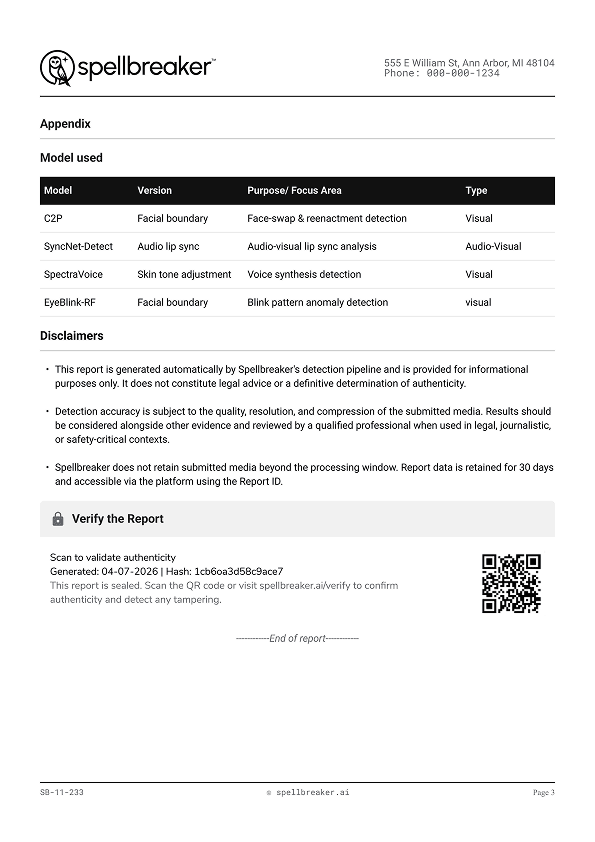
The full report behind this case study.

PDF · 20 pages
The complete Spellbreaker.ai redesign report: executive summary, introduction, research, key findings, design requirements, design and evaluation, the realization plan, and recommendations.
Download the report